


Quick Time › Guides › The Originals
This Quick Time Microgames guide is part of the Quick Time guides. For the controls, Time Coins, the shop and the Full Game at a glance, see the game overview.
The Originals are the Quick Time microgames every player gets for free: thirteen core games played with your thumb or the whole phone, plus five optional games for the microphone and camera. This page covers what each one asks, how you win, how you lose and what changes as it gets harder. The paid packs have their own pages: Arcade Classics, Hands On and Brain Teasers.
"Swipe!" Flat arrows appear one at a time; swipe each the way it points. A cleared arrow flies off and the next slides in. You start with one arrow and work up to five, and diagonal arrows join as the game levels up. A wrong swipe isn't counted (just swipe again), and one that's only slightly off is ignored. In Hard Mode, though, a swipe that's badly wrong loses the round. Classic uses a version with no diagonals.
Three versions: "Countdown to 0!" shows a big number of taps to make; "Tap the tile!" puts a tile in the middle; "Tap the screen!" makes the whole screen the target. The tile and screen change colour with every tap and turn green with a tick when you reach the count. It starts at a single tap and climbs to as many as ten. Normally the win lands the moment you reach the count. In Hard Mode the clock freezes there instead; stop for a beat to win, because one tap too many turns it red (the countdown shows OUT OF BOUNDS).
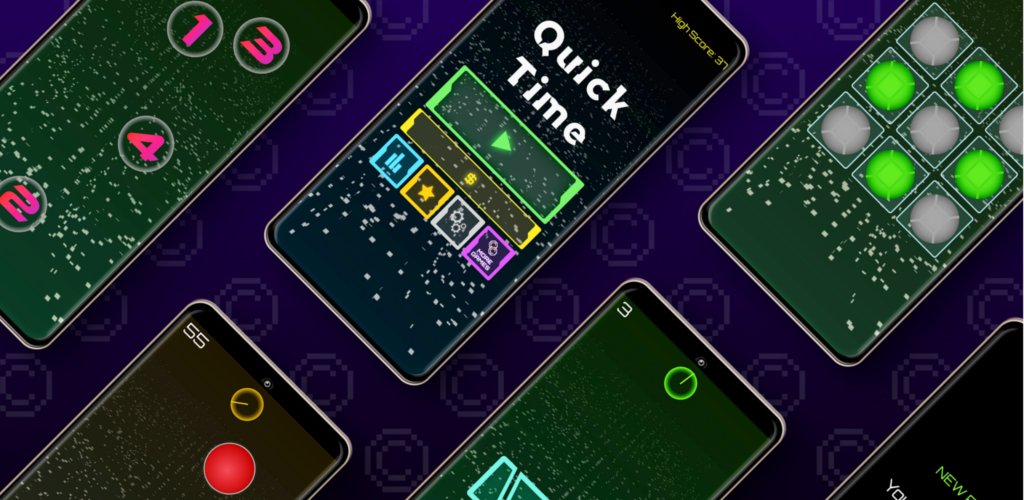
"Tap in order!" Numbered bubbles: tap 1, 2, 3 and so on, and each one turns green and stays. In the tougher "Chase the green!" version, every bubble is red except one green; tap it, it vanishes and another turns green, until the board is empty. In both, tapping out of order loses. Bubbles never overlap.
"Flip the switches!" Tap to switch things on; tap one that's already on and it switches off again. Light everything to win. The original version is a 3×3 grid of tiles. Later versions use real-looking switches, red bars when off and green when on with a white knob at one end, laid out in a grid, a row, a column or scattered across the board. At its first level only one is off; at the top, all of them are. The only way to lose is running out of time.
"Tap the green!" Tap the green, never a red; tapping empty space does nothing. In the moving grid the green hops from cell to cell among reds, faster as the run speeds up. The scattered version hides one green among more and more red circles. The bouncing version is a lone green circle bouncing off the edges, clicking on every bounce.
"Stop the needle!" A pointer moves along a bar with a green zone between two reds. Tap once while it's over the green, where a wobbling "TAP!" cheers you on; a tap in the red loses. Each style comes horizontal or vertical: the needle swings back and forth and slows at the ends; the arrows are two triangles either side of the bar moving at a steady pace; and the jump is one big arrow hopping between spots. A hop from red can land on green or red, a hop from green always lands on red, and the first green always arrives before the round is nearly over. The zone narrows as the game levels up, and the pointer gets faster with speed.
"Fill the tank!" or "Fill the screen!" Hold anywhere to fill and let go inside the band marked by dotted lines. The fill doesn't stop at the band: it shows red outside it and green inside, and keeps going until you let go or it's full. Letting go anywhere outside the band loses. Each round fills slowly, moderately or quickly, all faster as the run speeds up, and the band shrinks as the game levels up.
"Get to the green!" Drag the circle to the green goal without touching a wall. Lifting your finger isn't a fail; the circle just goes back to the start. Easy mazes are a straight line, moderate ones a single winding path, and hard ones full mazes with dead ends.
"Slide to green!" One slider at first, up to five. The track is red until the slider's in position, then green; the handle always stays white. In find the green, a hidden zone turns the track green while the handle is over it, and you lock it by letting go right there. In end to end, drag each handle all the way to the far end, at whatever angle the slider sits; it locks the moment it arrives. Normally a handle let go in the wrong place just stays put for another try. In Hard Mode it turns red and loses.
These read the phone's motion sensor, and only appear on phones that have one. Quick Time stays in portrait and never rotates the screen, which is what makes them work. Slow tilts are filtered out, so only real movement counts for shaking and holding still.
"Shake the phone!" A meter fills as you shake, with a charging sound, and turns green when full. In Hard Mode there's a dotted mark: reaching it freezes the clock, and holding still for a beat wins, but shaking on to the top turns it red.
"This side up!" A white arrow points any way but up, straight directions first and diagonals later. Turn the phone until it points up and it goes green. A phone lying flat has no "up", and if it happens to already be the right way at the start, you have to move it away first.
"Find the angle!" There's a hidden target tilt. The whole screen stays red while you search and turns green with a tick when you reach it; even passing through it counts. Chevrons stream across the screen showing which edge to tip down, and they shrink the closer you get.
"Hold still!" A white dot sits inside a dotted ring and drifts as the phone moves. Let it reach the ring and you lose; keep it inside until the timer runs out and you win. There's no grace period at the start.
These are off until you turn them on, in Arcade options or when the tutorial offers. Nothing is asked for up front: the phone only asks for microphone and camera access when you switch them on, and a game whose permission wasn't given is simply skipped. Sound and pictures are checked on your phone and thrown away. Nothing is recorded, stored or sent.
The camera games give you a longer round, because the camera takes a moment to open.
Quick Time microgames count towards several achievements too: First Clear (win your very first microgame), Full Set (win 13 different microgames), Steady Hands (win Hold Still 25 times) and Shake It Off (win Shake 50 times).
Ready to play the Quick Time Microgames yourself? Get Quick Time on Google Play and start with the free Originals.